


Ford Super Duty Towing Capacity Guide | Belle Fourche, SD
Ford Super Duty Towing Capacity Guide: F-250, F-350, and F-450 Specs Explained
A practical Belle Fourche guide to matching the right Super Duty to the trailer, hitch, and workload you actually have.
When people search for Ford Super Duty towing capacity, they usually want one thing. They want to know which truck can tow what, and whether an F-250 is enough or if they need to step up to an F-350 or F-450.
That is where things get messy fast. The Ford Super Duty lineup covers different engines, cab styles, axle ratios, bed lengths, rear-wheel setups, and hitch types. So there is no single towing number that applies to every truck wearing a Super Duty badge.
Still, there is a clean way to make sense of it. This guide breaks down Ford F-250 Super Duty towing capacity, Ford F-350 Super Duty towing capacity, and Ford F-450 Super Duty towing capacity, then explains what changes those ratings and which setup tends to make sense for real-world towing in western South Dakota, eastern Wyoming, and the northern Black Hills ranch country around Belle Fourche.
If you are comparing trucks right now, start with our Ford Super Duty inventory in Belle Fourche, then use this guide to narrow down whether an F-250, F-350, or F-450 fits your trailer and workload. For a trim-level comparison, see our F-250 vs F-350 guide.
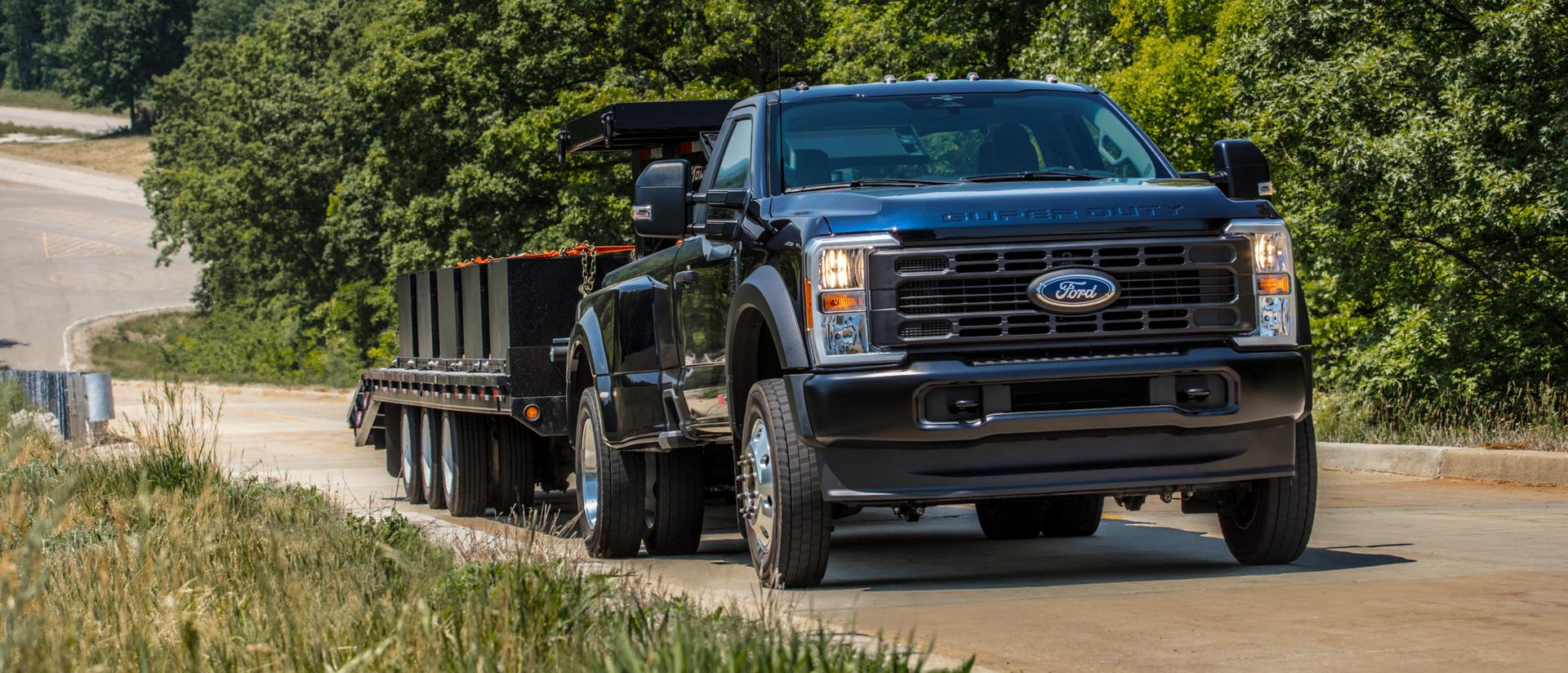


Ford Super Duty towing capacity at a glance
Up to 23,000 lbs gooseneck/fifth-wheel
Up to 27,600 lbs gooseneck/fifth-wheel
Up to 38,000 lbs gooseneck/fifth-wheel
Up to 40,000 lbs gooseneck
Those are max ratings under ideal configurations. You do not get every max number on the same truck at once. Cab, engine, axle ratio, drivetrain, and hitch type all change the final rating.
Ford Super Duty towing capacity chart
Here is the simplified version most shoppers are actually looking for. This chart uses the highest available ratings across the lineup so you can compare the big-picture difference between the F-250, F-350 SRW, F-350 DRW, and F-450.
| Model | Max Conventional Towing | Max Gooseneck / 5th-Wheel | Max Payload |
|---|---|---|---|
| F-250 SRW | 22,000 lbs | 23,000 lbs | 4,302 lbs |
| F-350 SRW | 25,000 lbs | 27,600 lbs | 4,706 lbs |
| F-350 DRW | 27,000 lbs | 38,000 lbs | 8,000 lbs |
| F-450 DRW | 30,000 lbs | 40,000 lbs | 6,482 lbs |
If you want to swap this for a branded chart later, this is the cleanest place to do it. For now, the table keeps the article readable and gives Google clear on-page context.
What affects Ford Super Duty towing capacity?
A lot of buyers assume towing capacity comes down to engine output alone. Power matters, obviously, but it is only part of the story.
A Super Duty truck’s tow rating changes based on engine choice, cab style, bed length, rear-wheel setup, axle ratio, drivetrain, and whether you are towing conventionally or with a fifth-wheel or gooseneck setup.
The big variables
- Engine choice
- Cab style and bed length
- Single rear wheel vs dually
- Axle ratio
- 4×2 or 4×4 drivetrain
- Conventional hitch vs gooseneck / fifth-wheel
What that means in plain English
Two trucks that both say F-350 on the side can have very different ratings. Regular Cab builds usually tow more than Crew Cab builds. They weigh less. Dually models tow more. They carry load better and stay more stable when the trailer gets serious.
Ford F-250 Super Duty towing capacity
The F-250 is where a lot of buyers start. It is the entry point into Ford’s heavy-duty truck lineup. Calling a truck with this kind of capability an entry point is a little funny.
When properly equipped, the F-250 can tow up to 22,000 pounds conventional, up to 23,000 pounds gooseneck/fifth-wheel, and carry up to about 4,300 pounds of payload. For many owners, that is already more truck than they will ever fully use.
F-250 engine towing ratings
Up to 17,300 lbs gooseneck
Up to 4,240 lbs payload
Up to 19,500 lbs gooseneck
Up to 4,246 lbs payload
Up to 22,900 lbs gooseneck
Up to 4,048 lbs payload
Up to 23,000 lbs gooseneck
Up to 3,918 lbs payload
For many RV owners, horse trailer owners, and contractors, the F-250 lands in the sweet spot. It is easier to live with than a dually, easier to park, and still brings serious heavy-duty towing confidence.
If that sounds close to your use case, browse the current Super Duty trucks for sale in Belle Fourche and compare the F-250 builds that are actually available.
Ford F-350 Super Duty towing capacity
The F-350 is where the lineup splits into very different use cases. You can order it as a single rear wheel truck or a dually, and that changes the numbers in a major way.
F-350 SRW
Up to 25,000 lbs conventional, up to 27,600 lbs gooseneck/fifth-wheel, and up to 4,706 lbs payload.
This is the middle-ground truck for buyers who want more towing headroom than an F-250 without jumping to dually ownership.
F-350 DRW
Up to 27,000 lbs conventional, up to 38,000 lbs gooseneck/fifth-wheel, and up to 8,000 lbs payload.
This is where heavy fifth-wheel towing, big pin weight, and stability start to become the entire conversation.
That payload difference matters. A lot of buyers focus only on the trailer rating and forget that pin weight, passengers, tools, fuel, and cargo all count against what the truck itself can safely carry.
If your trailer weight is creeping into the upper teens or beyond, or you are carrying bed-mounted equipment in addition to towing, the F-350 starts making a much stronger case than the F-250.
Ford F-450 Super Duty towing capacity
If you want the biggest number in the brochure, this is it. The F-450 tops the lineup at up to 30,000 pounds conventional, up to 40,000 pounds gooseneck, and up to 6,482 pounds payload.
That 40,000-pound max is the number most buyers remember, and fair enough, it is enormous. But it only happens with the right high-output diesel setup, axle ratio, and factory towing equipment.
Why the F-450 tows more
- Commercial-grade 19.5-inch wheels
- Heavy-duty brakes
- Wide-track front axle
- Dual rear wheels as standard
- High-output diesel configuration for the top-end ratings
For many retail buyers, an F-350 DRW will already be enough. The F-450 is really for buyers towing at the upper edge on a regular basis, including large equipment transport, agriculture use, multi-car trailers, and serious commercial hauling.
Conventional towing vs gooseneck towing
One of the biggest reasons Ford Super Duty towing numbers vary so much comes down to hitch type.
Conventional towing
This uses a receiver hitch behind the rear axle. It creates more leverage on the truck, so stability drops sooner as trailer weight climbs. That is why conventional ratings are always lower than gooseneck or fifth-wheel ratings.
Gooseneck and fifth-wheel towing
These setups place trailer weight over or slightly ahead of the rear axle. That improves balance, control, and weight distribution, which is why the jump in rated capacity can be huge on the same truck.
Which engine is best for towing?
Ford gives you four main Super Duty engines, and each one fits a different kind of buyer.
6.8L V8 Gas
405 horsepower and 445 lb-ft of torque. Good fit for buyers who need strong capability without stepping into diesel cost or maintenance.
7.3L V8 Gas
430 horsepower and 485 lb-ft of torque. The top gas option and a strong choice for buyers who want heavy work capability without diesel complexity.
6.7L Power Stroke Diesel
475 horsepower and 1,050 lb-ft of torque. Strong fit for frequent towing and bigger trailers where low-end torque really matters.
6.7L High-Output Power Stroke Diesel
500 horsepower and 1,200 lb-ft of torque. This is the engine that unlocks the biggest numbers in the lineup, including the highest F-450 towing ratings.
Ford Super Duty towing technology
Towing is not just about brute force anymore. The latest Super Duty trucks can include trailering tech that makes hitching, backing, payload balancing, lane changes, and trailer visibility a lot easier to manage in the real world.
Pro Trailer Hitch Assist
Helps line the truck up with the coupler so hitching is less of a hassle.
Pro Trailer Backup Assist
Makes backing a trailer less stressful, especially when you do not tow every day.
Onboard Scales with Smart Hitch
Useful for understanding payload balance and tongue weight before you are guessing past the limit.
Trailer Navigation and Camera Views
These are the features that matter once you are lane-changing, backing up, or towing through traffic and tight fuel stops.
F-250 vs F-350 vs F-450: which Super Duty is right for you?
Here is the clean version.
- Choose the F-250 if you want a heavy-duty truck that can still work as a daily driver and still tow big campers, work trailers, or recreational loads.
- Choose the F-350 SRW if you want more towing headroom without stepping into dually ownership.
- Choose the F-350 DRW if you tow heavy fifth-wheel or gooseneck trailers regularly and want much more payload and stability.
- Choose the F-450 if you need the highest towing capacity in the lineup and use it for serious commercial or industrial work.
The right answer depends on trailer weight, hitch type, how often you tow, and how much payload you carry in the truck itself. Bigger is not automatically better if you do not need the extra hardware every day.
If you are still comparing, our new Ford inventory in Belle Fourche gives you the full new-truck picture. The Super Duty inventory page stays focused on heavy-duty builds. Shopping a fifth-wheel RV? Pair this guide with our best Super Duty for fifth-wheel decision page.
How to shop Super Duty towing the right way
Max tow when properly equipped is a brochure peak. Your truck on the lot may rate lower. Walk this path before you fall in love with a trim badge.
- Write down loaded trailer weight, hitch type (conventional, fifth-wheel, or gooseneck), and how often you tow.
- Estimate pin weight or tongue weight. Pin weight often eats payload first on fifth-wheels.
- Add people, fuel, tools, and bed cargo to the truck side of the ledger.
- Compare that plan to payload and tow ratings on the specific VIN, not to a max chart alone.
- Ask about axle ratio, cab, bed, SRW vs DRW, and factory tow equipment on that build.
- Confirm GCWR language on Ford materials and the door sticker. GCWR is the combined rating for truck plus trailer when the combination is properly equipped.
Payload is what the truck can carry: passengers, fuel, hitch hardware, bed cargo, and pin or tongue weight. Max tow when properly equipped is the highest published tow figure for that model family under the right configuration. Your truck may not hit that peak. GCWR caps the combined weight of the truck and trailer. Stay inside every limit that applies, not just the biggest number on a chart.
We keep this page conservative. Ratings already listed above come from Ford Super Duty materials already documented in this guide. Re-check Ford.com and the window sticker before you buy. Numbers can change by model year and equipment.
Need help picking the right Super Duty for your trailer?
Bring the trailer weight, hitch type, cargo plan, and how often you tow. We will help you compare F-250, F-350, and F-450 setups without turning it into a spreadsheet punishment exercise. Visit Belle Fourche Ford at 30 5th Ave, Belle Fourche, SD or call sales at 605-699-4158.
Ford Super Duty towing capacity FAQ
What is the maximum Ford Super Duty towing capacity?
The maximum Ford Super Duty towing capacity is 40,000 pounds, available on a properly equipped Ford F-450 Super Duty with a gooseneck setup.
What is the Ford F-250 Super Duty towing capacity?
The Ford F-250 Super Duty can tow up to 22,000 pounds conventionally and up to 23,000 pounds with a gooseneck or fifth-wheel hitch, depending on configuration.
What is the Ford F-350 Super Duty towing capacity?
The Ford F-350 Super Duty can tow up to 25,000 pounds conventional in SRW form and up to 38,000 pounds gooseneck in DRW form when properly configured.
What is the Ford F-450 Super Duty towing capacity?
The Ford F-450 Super Duty can tow up to 30,000 pounds conventionally and up to 40,000 pounds with a gooseneck hitch when properly equipped.
Does cab style affect Ford Super Duty towing capacity?
Yes. Regular Cab models usually have higher towing capacity than Crew Cab models. They weigh less, which can leave more rating on the table when properly equipped.
Is gooseneck towing better than conventional towing?
For heavier loads, yes. Gooseneck towing usually gives you a higher tow rating and better stability. Trailer weight sits over the rear axle instead of behind it.
What is GCWR on a Super Duty?
GCWR is the gross combined weight rating for the truck and trailer together when properly equipped. Stay inside GCWR plus payload and tow limits for the VIN you buy.
What does max tow when properly equipped mean?
It is the highest published tow figure for that Super Duty family under the right configuration. Your truck on the lot may rate lower. Confirm the door sticker and Ford materials for that VIN.
