


2026 Ford Bronco vs Toyota 4Runner: Full Comparison
The 2026 Ford Bronco and the fully redesigned 2026 Toyota 4Runner are the two most talked about midsize, body-on-frame SUVs on the market. Both are built for real off-road use, both offer serious power, and both carry decades of history. They just chase that goal in very different ways.
The Bronco is a modular, open-air machine built around trail geometry and customization. The 4Runner is a fully enclosed, hybrid-available overland platform built on Toyota’s global truck chassis for refinement, towing, and long-term durability. This guide breaks down trims, pricing, powertrain specs, off-road capability, interior space and size, technology, safety, and reliability so you can decide which one fits how you actually drive.
This comparison is for any driver shopping a new Bronco or a new 4Runner. When the two SUVs are compared side by side, the difference is use case, not a mystery spec sheet. The tables keep the factory specs already on this page. Confirm details on the window sticker of the exact vehicle you want.
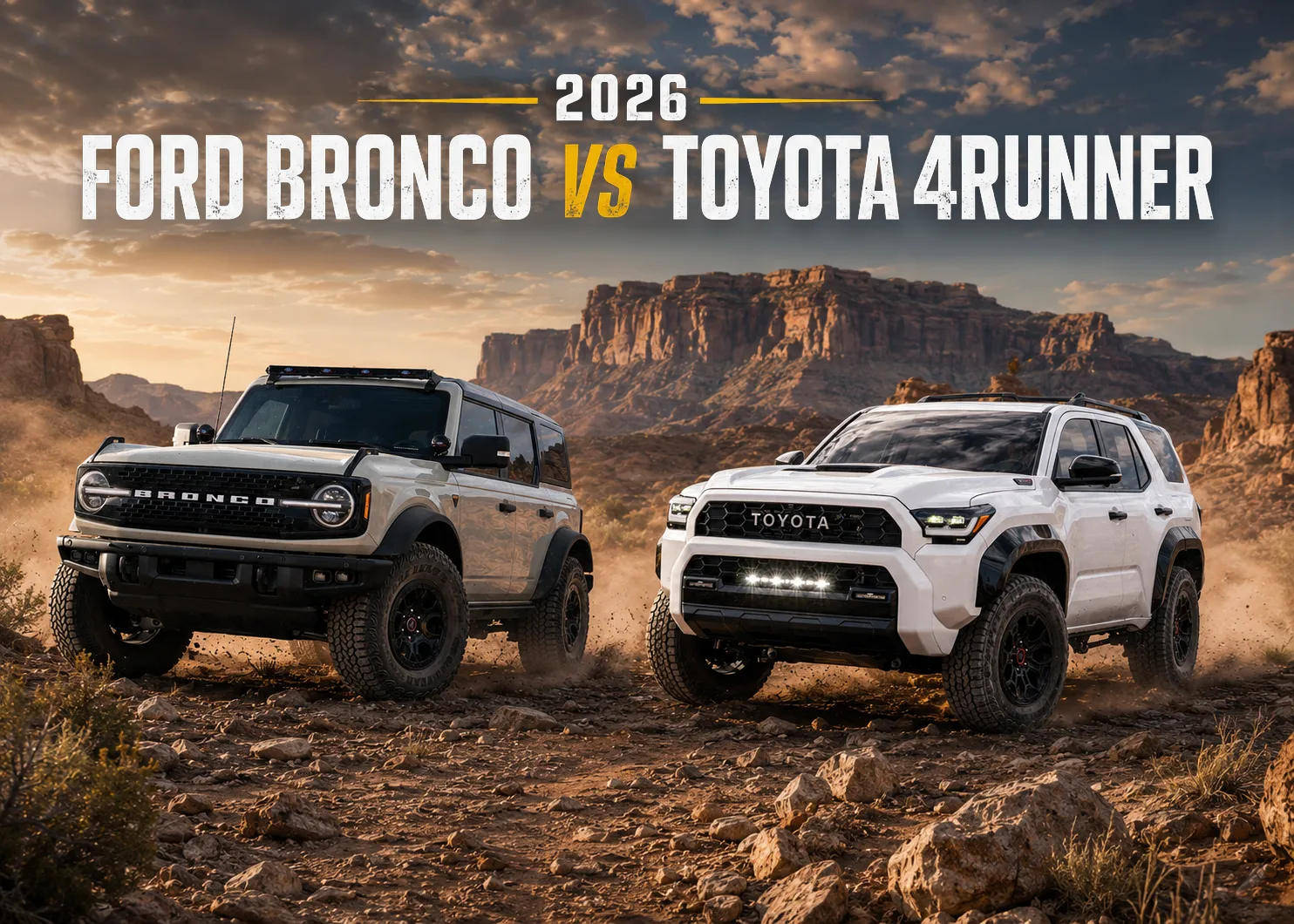
Bronco vs 4Runner at a glance
If you want the short version before the full breakdown, here is how the two vehicles separate when they are compared:
Pick the Ford Bronco if
- You want the strongest trail geometry and water fording
- You like open-air driving with removable doors and roof
- You want a proven engine lineup and a huge aftermarket
- You prefer quicker acceleration and a manual option
Pick the Toyota 4Runner if
- You tow heavier loads or overland with a full gear setup
- You want a quieter, more insulated highway ride
- You want hybrid torque, better mpg, and onboard AC power
- You value long-term reliability and available third-row seating
Trim lineups and pricing
The Bronco offers two-door or four-door body styles across a modular lineup, from the accessible Base (the base model) up to the extreme Raptor. For 2026, Ford adds heritage-focused looks like the 60th Anniversary model (Sasquatch-equipped Outer Banks with red and white styling), the returning Wildtrak with standard Fox internal bypass dampers and 35-inch tires, and the desert-ready Stroppe Edition.
The 4Runner is fully redesigned on Toyota’s TNGA-F global platform and offers nine trims, but only in a four-door wagon body. Highlights include the TRD Sport, the overlanding Trailhunter (bronze wheels, ARB roof rack, onboard air compressor), and the flagship TRD Pro with an exclusive blue paint option.
| Ford Bronco trim | Base MSRP | Toyota 4Runner trim | Base MSRP |
|---|---|---|---|
| Base (2-Door / 4-Door) | $40,795 | SR5 (RWD / 4WD) | $41,870 |
| Big Bend (4-Door) | $41,790 | TRD Sport (RWD / 4WD) | $48,350 |
| Outer Banks (4-Door) | $48,685 | TRD Off-Road (4WD) | $50,290 |
| Badlands (2-Door / 4-Door) | $49,385 | Limited (RWD / 4WD) | $56,500 |
| Heritage Edition (4-Door) | $52,120 | TRD Off-Road Premium Hybrid (4WD) | $58,870 |
| Stroppe Edition (4-Door) | $69,995 | Trailhunter Hybrid (4WD) | $68,000 |
| Raptor (4-Door) | $80,990 | TRD Pro Hybrid (4WD) | $68,200 |
Pricing is base MSRP and excludes destination, taxes, and fees. A base model Bronco is the entry point. Trims and prices can change during the model year. Confirm current pricing and availability with the dealership.
Powertrain and performance
Ford uses turbocharged EcoBoost gas engines with a manual or automatic choice on the base engine. The standard 2.3-liter EcoBoost four-cylinder makes 300 horsepower and 325 lb-ft, and it can be paired with a class-exclusive seven-speed manual (with a crawler gear) or a ten-speed automatic. The 2.7-liter twin-turbo V6 steps up to 330 horsepower and 415 lb-ft, and the Bronco Raptor’s 3.0-liter twin-turbo V6 delivers 418 horsepower and 440 lb-ft.
Toyota has gone all-in on a turbocharged four-cylinder. The standard 2.4-liter i-FORCE makes 278 horsepower and 317 lb-ft. The i-FORCE MAX hybrid adds a 48-horsepower electric motor for a combined 326 horsepower and 465 lb-ft, with peak torque arriving at just 1,700 rpm. That instant torque helps eliminate low-speed turbo lag on technical climbs, and it lifts 4Runner towing to a class-leading 6,000 pounds.
| Metric | Bronco 2.3L I-4 | Bronco 2.7L V6 | 4Runner 2.4L Gas | 4Runner Hybrid MAX |
|---|---|---|---|---|
| Horsepower | 300 hp | 330 hp | 278 hp | 326 hp |
| Torque | 325 lb-ft | 415 lb-ft | 317 lb-ft | 465 lb-ft |
| Transmission | 7-spd manual / 10-spd auto | 10-spd auto | 8-spd auto | 8-spd auto |
| 0 to 60 mph | 7.1 sec (auto) | 6.2 sec | 7.5 sec | 6.7 sec |
| Passing 50 to 70 mph | 4.6 sec | 4.4 sec | 5.2 sec | 4.8 sec |
| Max towing | 3,500 lbs | 3,500 lbs | 6,000 lbs | 6,000 lbs |
| EPA combined mpg | 20 mpg | 18 mpg | 22 mpg | 23 mpg (est.) |
The takeaway: the Bronco is quicker in a straight line thanks to lighter weight and a fast ten-speed automatic. The 4Runner counters with more torque, better fuel economy, and nearly double the towing capacity when properly equipped. Highway fuel economy still favors the 4Runner in the table above.
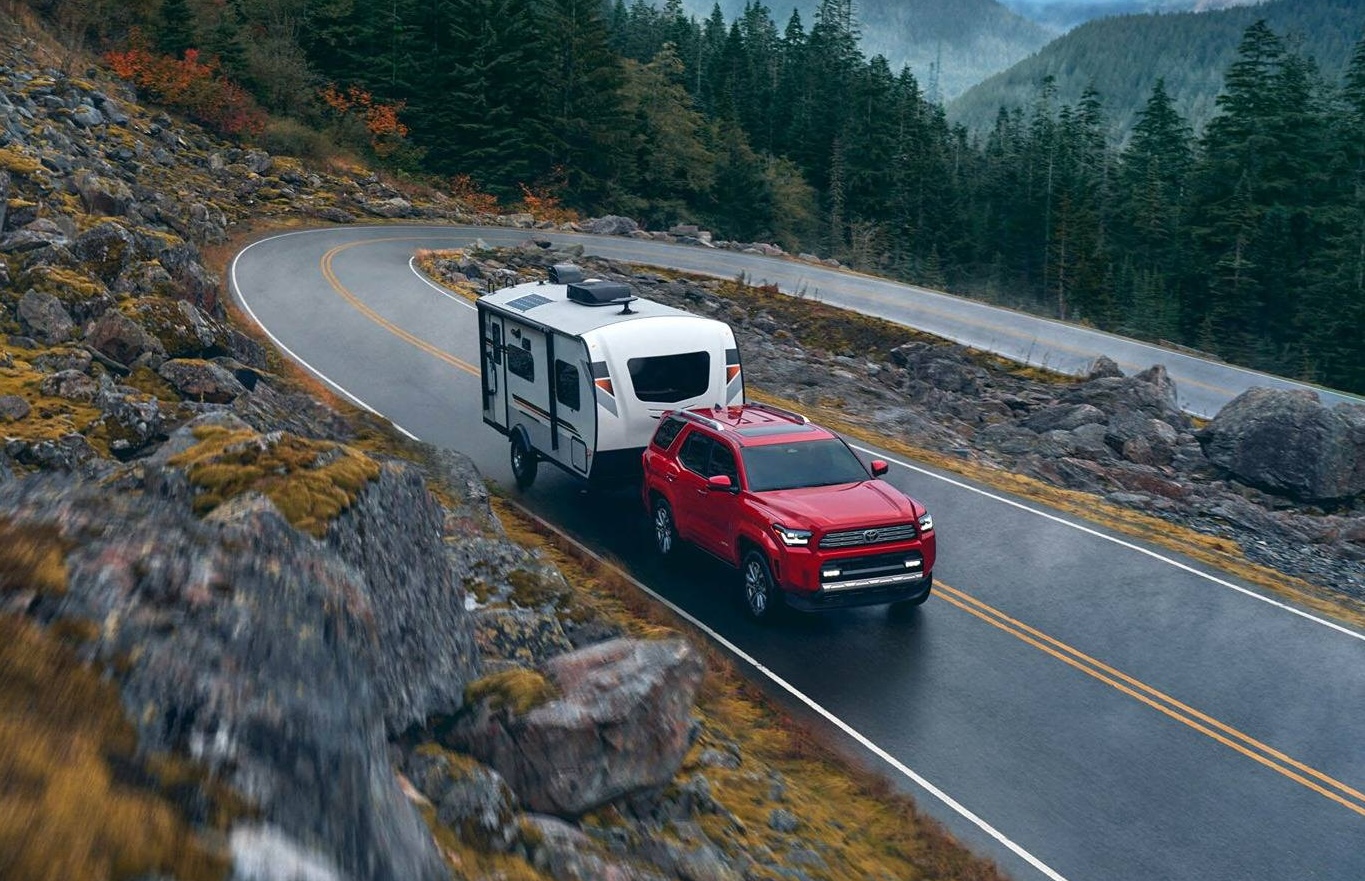
Off-road capability and suspension
This is where the Bronco makes its clearest case as the more trail-capable vehicle. Ford’s High-Performance Off-Road Stability Suspension (HOSS) scales from base setups to Bilstein position-sensitive dampers on Badlands and Sasquatch trims. The Sasquatch package adds 35-inch tires on beadlock-capable wheels, front and rear electronic locking differentials, and a hydraulic front sway-bar disconnect. That lifts ground clearance to 11.6 inches and water fording to 33.5 inches. The Raptor goes further still, with up to 13.1 inches of clearance and 37 inches of fording.
Toyota answers with trim-specific tuning: Bilstein monotube shocks on TRD Off-Road, Old Man Emu 2.5-inch forged shocks plus an onboard air compressor on the overlanding Trailhunter, and high-speed FOX dampers with a front sway-bar disconnect on the TRD Pro. The 4Runner is very capable, but its factory clearance angles and 27.6-inch wading limit trail the Bronco’s most aggressive setups.
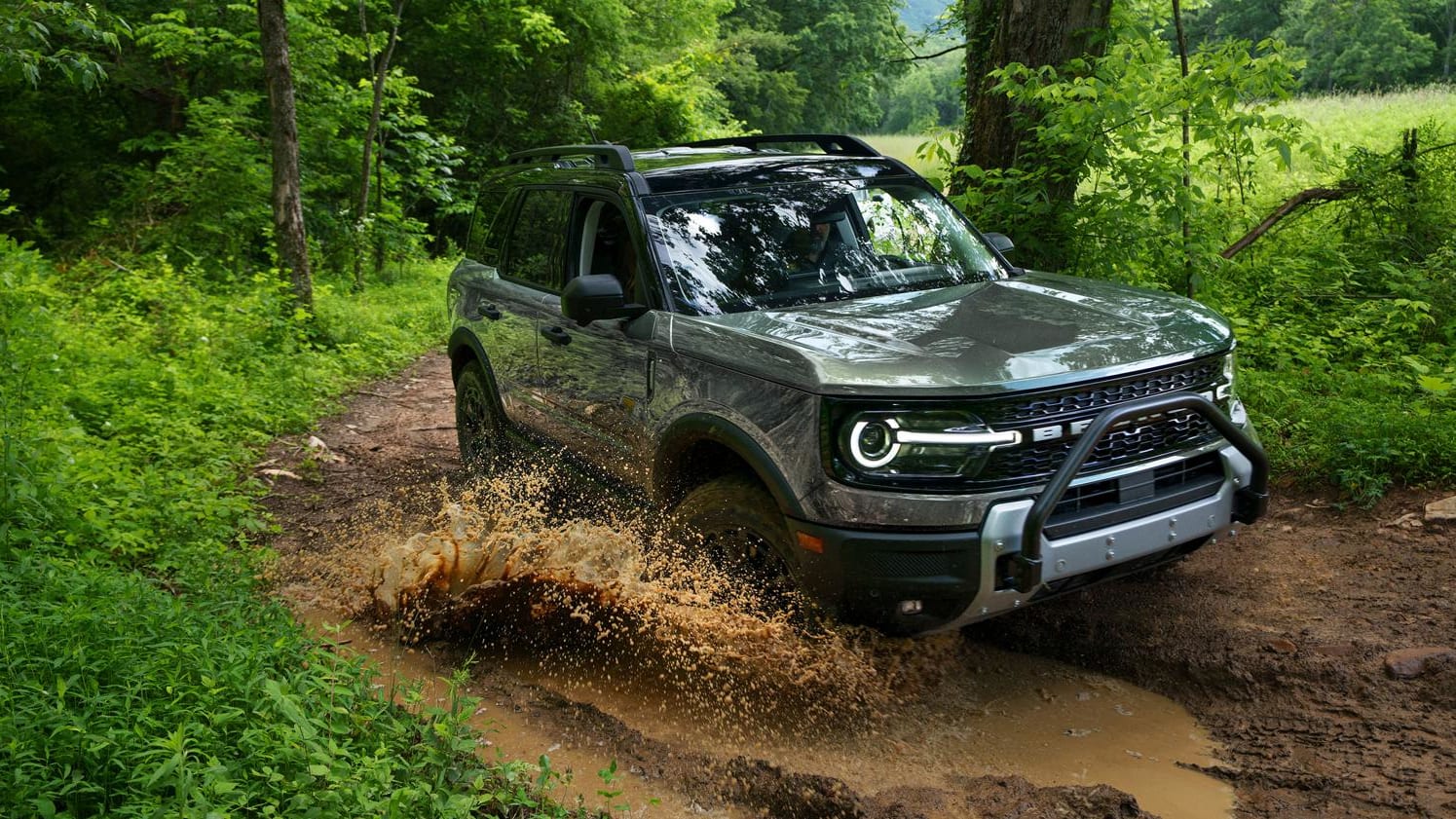
| Geometry | Bronco (Base 4-Door) | Bronco (Sasquatch) | 4Runner (SR5) | 4Runner (Trailhunter / TRD Pro) |
|---|---|---|---|---|
| Ground clearance | 8.3 in | 11.6 in | 8.1 in | 10.1 in |
| Approach angle | 35.5 deg | 43.2 deg | 18.0 deg | 33.0 deg |
| Departure angle | 29.5 deg | 37.2 deg | 22.0 deg | 24.0 deg |
| Breakover angle | 20.0 deg | 29.0 deg | 23.0 deg | 24.0 deg |
| Water fording | 31.5 in | 33.5 in | 27.0 in | 27.6 in |
| Sway-bar disconnect | No | Hydraulic (Badlands) | No | Electronic (TRD Pro) |
Two backcountry features worth knowing
The Bronco has a coolant limp-home mode: if the cooling system is compromised on a remote trail, the engine can deactivate half its cylinders to reduce heat and let you limp to safety. The 4Runner does not offer that backup.
The hybrid 4Runner counters with a 2,400W AC power inverter fed by its traction battery, so you can run high-draw campsite gear straight from the vehicle. The Bronco does not offer a high-wattage onboard generator.
Interior space, seating, and cargo
The 4Runner has the larger footprint and, in gas form, the bigger cargo hold, up to 90.2 cubic feet of cargo volume with the seats folded. Packaging the hybrid battery under the floor drops that cargo volume to 82.6 cubic feet. A key advantage: gas SR5 and Limited trims offer an optional third row for up to seven passengers. Hybrid models stay five-seat only. Passenger volume is not a figure we independently verified for this page, so use seating capacity and cargo volume when you compare space.
The four-door Bronco seats five and offers up to 77.6 cubic feet of maximum cargo, plus something the 4Runner cannot match: removable doors and a removable roof for a true open-air experience. The two-door Bronco trades cargo room for a shorter, more maneuverable body. A two-door build feels tighter on the trail. A four-door build is easier for daily cargo once the two vehicles are compared on the lot, wheel and package included.
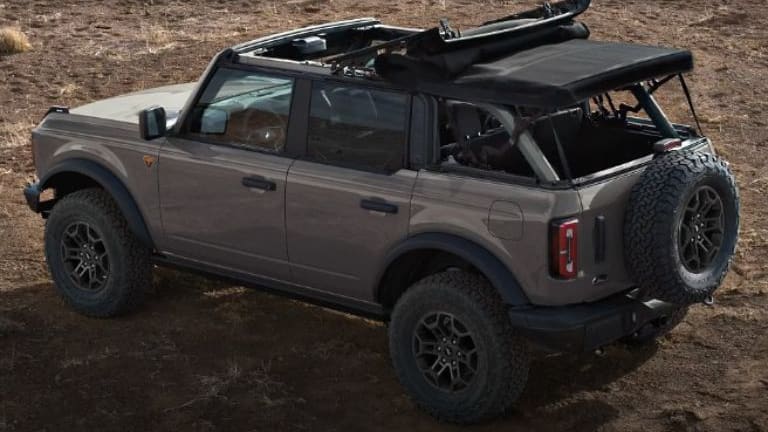
| Dimension | Bronco 2-Door | Bronco 4-Door | 4Runner (Gas) | 4Runner (Hybrid) |
|---|---|---|---|---|
| Overall length | 173.7 in | 189.4 in | 194.9 in | 194.9 in |
| Seating capacity | 4 | 5 | 5 to 7 | 5 |
| Rear legroom | 35.7 in | 36.3 in | 34.8 in | 34.8 in |
| Cargo (seats down) | 52.3 cu ft | 77.6 cu ft | 90.2 cu ft | 82.6 cu ft |
| Fuel tank | 16.9 gal | 20.8 gal | 19.0 gal | 19.0 gal |
Technology and safety
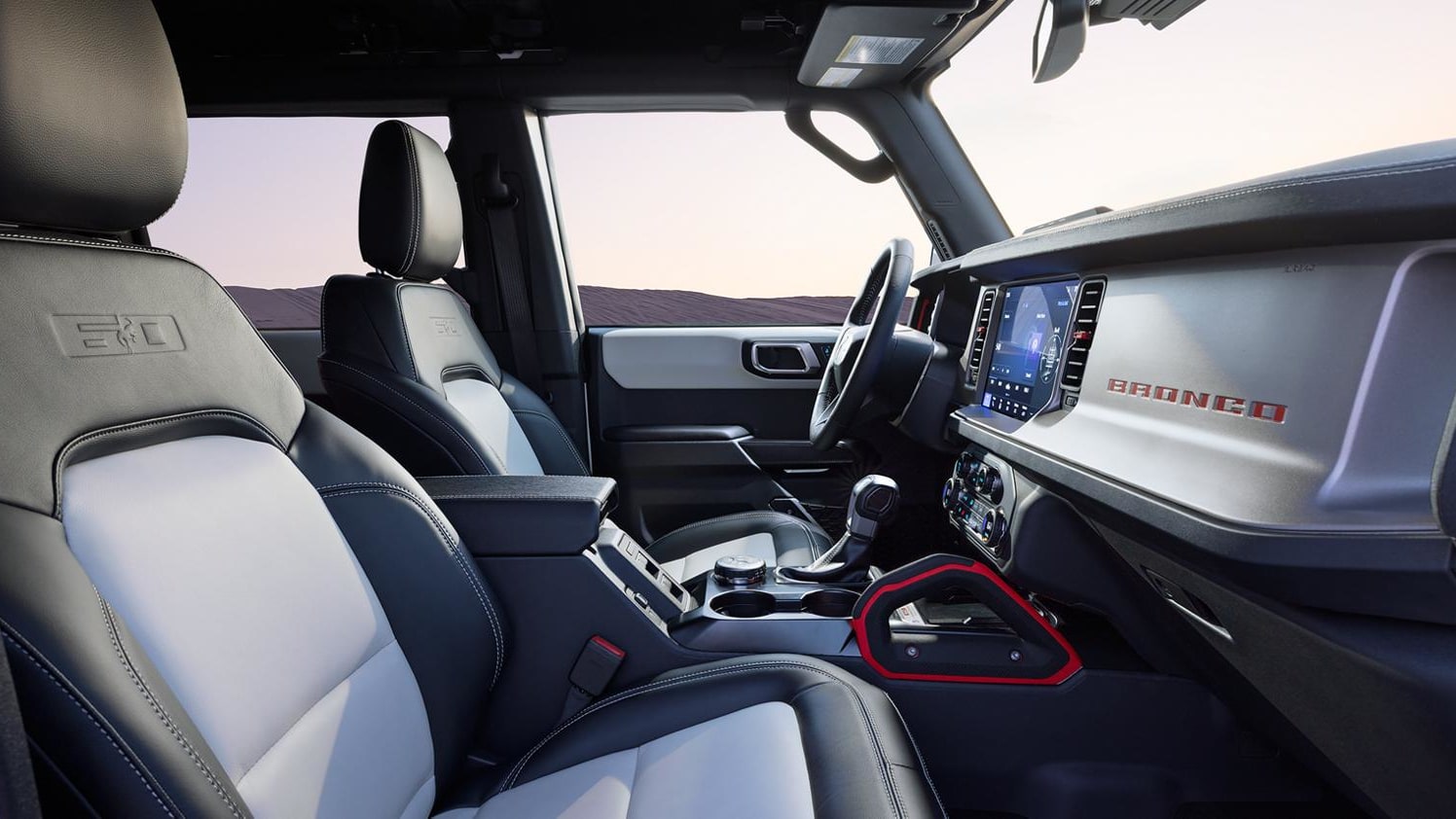
The Bronco leads on standard screens, with a 12.0-inch touchscreen and a 12.0-inch digital cluster standard. The 4Runner starts with an 8.0-inch touchscreen and a 7.0-inch cluster, with larger 14.0-inch and 12.3-inch displays available on higher trims.
Both include strong standard driver-assist suites: Ford Co-Pilot360 on the Bronco and Toyota Safety Sense 3.0 on the 4Runner. Toyota adds standard front knee airbags and height-adjustable front seatbelts, plus larger 13.4-inch front brake rotors that support its higher tow rating. On crash testing, the Bronco earns a five-star NHTSA front rating and IIHS “Good” small-overlap results, while the redesigned 2026 4Runner has not yet been fully rated for the new platform.
| Feature | 2026 Ford Bronco | 2026 Toyota 4Runner |
|---|---|---|
| Standard touchscreen | 12.0 in | 8.0 in (14.0 available) |
| Standard gauge cluster | 12.0 in | 7.0 in (12.3 available) |
| Standard safety suite | Ford Co-Pilot360 | Toyota Safety Sense 3.0 |
| Front brake rotors | 12.2 in | 13.4 in |
| Standard front knee airbags | No | Yes |
| NHTSA front crash rating | 5 stars | Not yet rated |
Reliability and long-term ownership
Quality data splits in an interesting way. In J.D. Power’s Initial Quality Study, which tracks problems in the first 90 days, Ford scored better, with seven fewer problems per 100 vehicles than Toyota. Most of those early complaints are infotainment and software related, and Toyota’s more conservative interfaces avoid some of that friction.
Long-term dependability leans the other way. Consumer Reports ranks Toyota near the top of its three-year ownership surveys and gives the 4Runner a predicted reliability rating of 95 out of 100. The catch for 2026 is that this 4Runner is all-new, with a new frame, new hybrid system, and new electronics, so first-year unknowns exist. If you want the most proven combination available today, the Bronco 2.7L V6 is a settled, well-sorted option.
Which one should you buy?
Choose the Ford Bronco if your priority is trail-ready capability, open-air driving, quicker acceleration, and a massive aftermarket for accessories. Its approach, departure, and breakover angles, sway-bar disconnect, 35-inch tire packages, and deeper water fording make it the more specialized off-roader, and the removable top and doors make it more fun day to day.
Choose the Toyota 4Runner if you tow heavier loads, overland with a full gear setup, want hybrid efficiency and onboard AC power, or need an optional third row and a quieter highway ride. It carries Toyota’s long-term reliability reputation, with the caveat that the 2026 model is a first-year redesign.
A Jeep Wrangler is a different trail-ready option some shoppers ask about. This page stays on Bronco vs 4Runner. Pick the build that matches how you drive, then confirm the factory wheel, package details, and aftermarket accessories on the lot. Shoppers who compared both vehicles usually land on the build that matches trail days versus tow days.
Frequently asked questions
Is the Ford Bronco better than the Toyota 4Runner?
The better pick comes down to how you drive. The Bronco is the better dedicated off-roader, with stronger clearance angles, deeper water fording, quicker acceleration, and an open-air design. The 4Runner is the better tow rig and long-distance overlander, with more torque, better fuel economy, up to 6,000 pounds of towing, and available seven-passenger seating.
What are the negatives of a Ford Bronco?
Most of the Bronco’s trade-offs come straight from its trail-first, open-air design. The removable roof and doors let in a little more wind noise than a fully sealed SUV, lower trims use more wipe-clean hard-surface materials made for muddy adventures, and it is tuned for capability rather than maximum towing (3,500 pounds). In return you get class-leading clearance and approach angles, removable doors and a removable top, quicker acceleration, an available manual transmission, and one of the largest aftermarket ecosystems of any SUV, which is exactly what most Bronco buyers want.
What is the Ford equivalent to the 4Runner?
The Ford Bronco is the closest match. Both are midsize, body-on-frame SUVs built for off-road use and available in trail-focused trims. The 4Runner leans toward overlanding and towing, while the Bronco leans toward technical trail capability and open-air driving.
Does the Bronco or 4Runner tow more?
The 4Runner has the higher maximum rating, up to 6,000 pounds versus 3,500 pounds for the Bronco when each vehicle is properly equipped, so it is the pick if you regularly tow a large travel trailer or boat. For most Bronco owners, 3,500 pounds comfortably covers popular utility trailers, small campers, dirt bikes, side-by-sides, and personal watercraft.
Which is more reliable, the Bronco or the 4Runner?
Ford scored better on short-term initial quality (fewer problems in the first 90 days), while Toyota has a stronger long-term dependability reputation, with the 4Runner earning a 95 out of 100 predicted reliability score from Consumer Reports. Keep in mind the 2026 4Runner is a first-year redesign, so its new hybrid and electronics are less proven than the Bronco’s established engines.
Which gets better gas mileage?
The 4Runner wins on fuel economy. The gas 4Runner returns about 22 mpg combined and the i-FORCE MAX hybrid about 23 mpg combined, versus roughly 18 to 20 mpg combined for the Bronco’s EcoBoost engines.
Want to keep comparing a new Bronco to a 4Runner? Browse current new Bronco inventory or explore the full new Ford lineup at Belle Fourche Ford.
Test drive the 2026 Ford Bronco at Belle Fourche Ford
The best way to settle the Bronco vs 4Runner debate is a test drive. Sit in the driver seat, check the factory wheel and package on the window sticker, then pick the vehicle that matches how you actually use it. Visit Belle Fourche Ford at 30 5th Ave, Belle Fourche, SD 57717, or call 605-892-2643 to check current Bronco inventory.

0 comment(s) so far on 2026 Ford Bronco vs Toyota 4Runner: Full Comparison