


Which F-150 Generation Should You Buy?
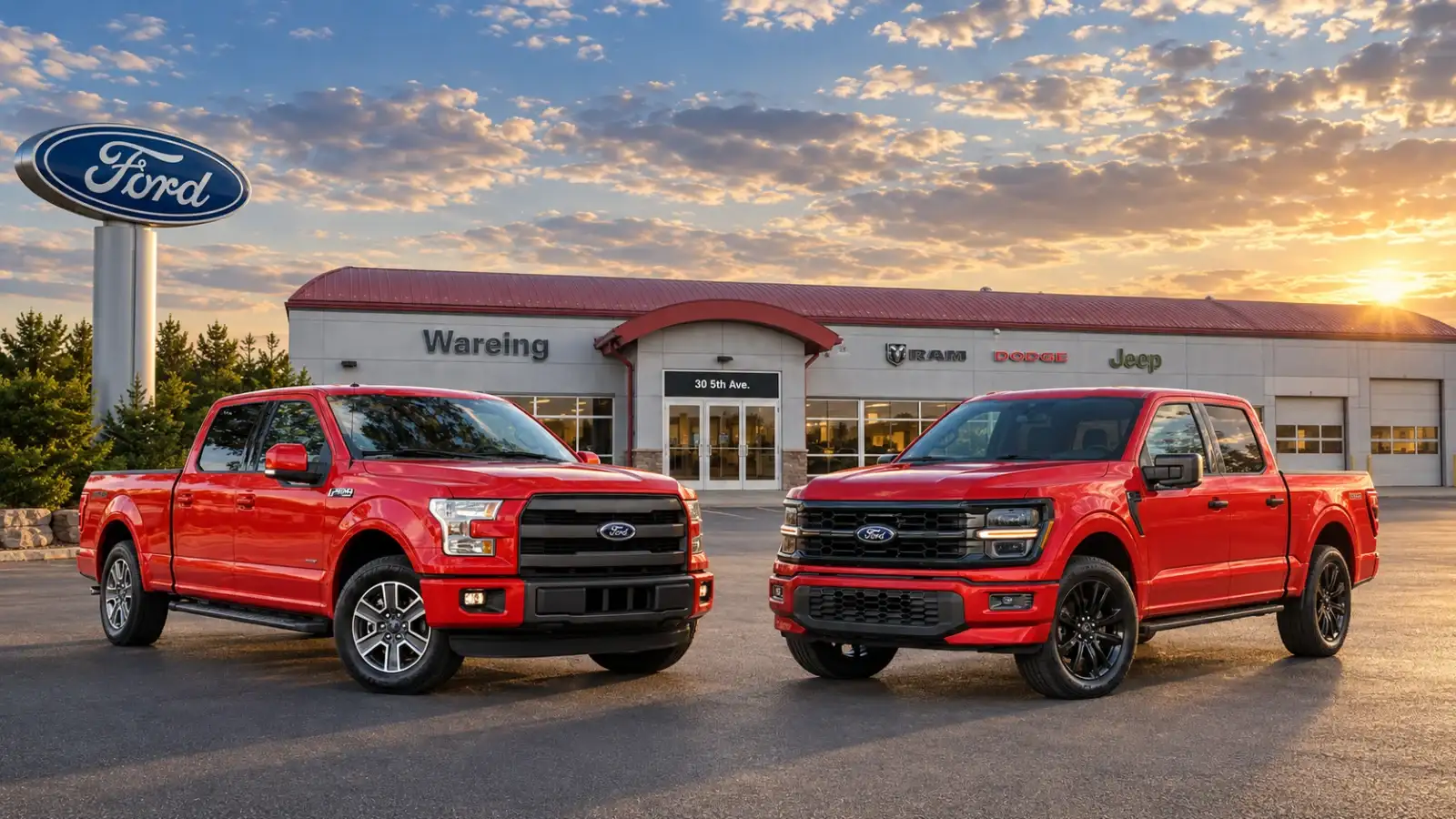
Belle Fourche Ford
Which F-150 generation should you buy?
Choosing a cab or bed first? Read our 2026 Ford F-150 cab and bed sizes guide for Ford’s five published combinations, box dimensions, and overall length before you pick a truck.
A buyer guide to Ford F-150 generations for Belle Fourche, Spearfish, and the Black Hills. Not a museum timeline.
People search F-150 generations when they want a truck they can live with. You might be looking at a used tenth-gen work truck, a 2015-2020 aluminum-body crew cab, or a new 2026 truck on the lot. The generation tells you the platform, the body, and the kind of problems you should check before you spend the money.
This page is written for that decision. Belle Fourche Ford can walk you through new F-150 inventory, used Fords, and what a door sticker actually means. Year ranges below follow Autoweek’s F-Series generation guide. Capability numbers for current trucks come from Ford.com.
If you already know you want a 2026 trim walkthrough, use our 2026 F-150 trim guide. If you want a South Dakota Ford rooftop, start at the Belle Fourche Ford dealer page.
Quick take for shoppers here
- Buy a current 2026 F-150 if you want Ford’s published max of 13,500 lbs towing or 2,440 lbs payload on a properly equipped truck.
- Shop 2015-2020 (13th gen) if you want the aluminum-body era at used money. Inspect prior body repair, the frame, and the bed carefully.
- Shop 2009-2014 (12th gen) if you want a steel-body truck and you can leave room in the budget for age-related repairs.
- Treat anything older as a project, collector truck, or ranch spare unless records are clean and the frame is honest.
How to read F-150 generations
The Ford F-Series started in 1948. Ford introduced the F-150 name in 1975 during the sixth generation. People still use “F-150 generations” for the full history of these half-ton Ford trucks. Cab, bed, four-wheel drive, and engine options can change the truck more than the generation number alone.
A generation is a platform. Two trucks from the same generation can still tow very different numbers. Confirm payload and towing on the door label and the window sticker. Do not use a brochure maximum as your trailer number.
Start with your job, then choose a Ford F-150 generation
A generation chart is useful only after you define the work. Write down how many people ride in the cab, what has to fit in the bed, whether you need four-wheel drive, and the loaded weight of any trailer. Decide whether onboard power, current driver-assistance features, or a simpler older truck matters more to you.
- Cab and interior space: Regular Cab, extended cab, and four-door crew cab layouts serve different jobs. Check rear-seat room in person.
- Bed and cargo space: Bed length affects building supplies, ATVs, toolboxes, and trailer clearance. Measure your normal cargo.
- Engine performance: Compare the engine in the actual truck, its maintenance history, and its vehicle-specific ratings.
- Four-wheel drive: Engage every mode during the test drive. Listen for binding, clunks, or delayed engagement.
- Payload and towing capabilities: Count people, cargo, accessories, and trailer tongue weight against the label on the truck.
- Condition: A clean frame and documented service can make an older F-150 a better buy than a neglected newer one.
This approach gives Belle Fourche shoppers a broader range of workable trucks without pretending one model year is best for every owner.
What each modern era is like to own
14th generation, 2021 to now (including 2026)
This is the truck on Ford.com today. Aluminum panels over a steel frame stay in the mix. Hybrid PowerBoost arrives in this generation. Ford lists 2026 max available towing at 13,500 lbs and max available payload at 2,440 lbs when the truck is set up for those ratings.
Ford’s published engine tow ceilings for 2026: 2.7L EcoBoost 8,400 lbs, PowerBoost hybrid 11,600 lbs, 5.0L V8 12,800 lbs, 3.5L EcoBoost 13,500 lbs. PowerBoost is listed at 430 hp and 578 lb-ft. The 3.5L EcoBoost is listed at 400 hp and 500 lb-ft.
Buy this era if you want available Pro Power Onboard generator capability, current safety features, and a factory warranty on a new unit. Feature availability varies by configuration. Come test drive what is in Belle Fourche. Inventory moves. Sales: 605-699-4158.
13th generation, 2015 to 2020
This is the aluminum-body jump. EcoBoost V6 trucks are common. Plenty of ranch buyers around Spearfish and Belle Fourche still use these as daily drivers.
Inspect prior accident repair, the bed, the frame, and the cooling system. Ask for complete engine and transmission service records. Payload still lives on the door sticker, not in a forum post.
12th generation, 2009 to 2014
Steel body. Taller, heavier look. Raptor joins the family here. These trucks still work if the frame is clean. Age, weather, gravel roads, and prior work can leave visible wear underneath.
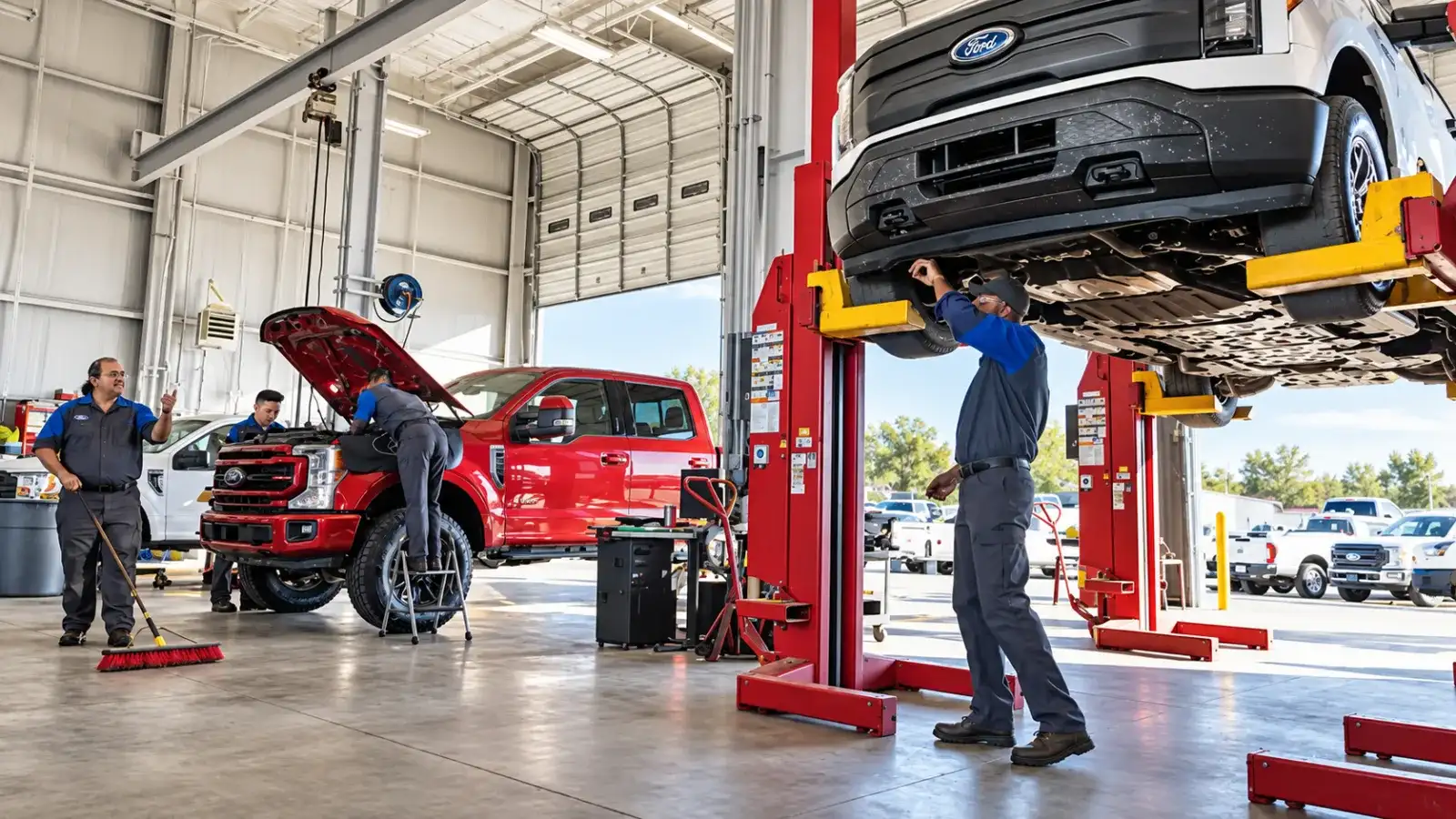
Budget time for age, rust, front-end wear, fluid leaks, and deferred maintenance. Have a tech look at it. Our service lane can inspect a used Ford you are considering.
10th and 11th generations, 1997 to 2008
1997-2003 is the first rounded “modern” F-150. 2004-2008 gets larger and more car-like inside. Autoweek calls the 10th gen the first truly new F-Series since 1980.
These can be honest work trucks. They can be tired. Look at the frame, cab mounts, exhaust manifold leaks, and whether the 4×4 actually engages. Price them as used tools, not as new trucks with extra miles.
Older F-Series, 1948 to 1996
Square-body ninth gen (1992-1996) and earlier trucks show up as ranch beaters and restorations. The F-150 badge starts in 1975. Crew cab arrives in 1965. Four-wheel drive becomes a factory option in 1958.
Fun to own. Hard to treat as a daily with airbags, modern brakes, and current towing electronics. If you want a trailer truck for I-90 or Highway 212, start with 13th or 14th gen unless you already know the older truck.
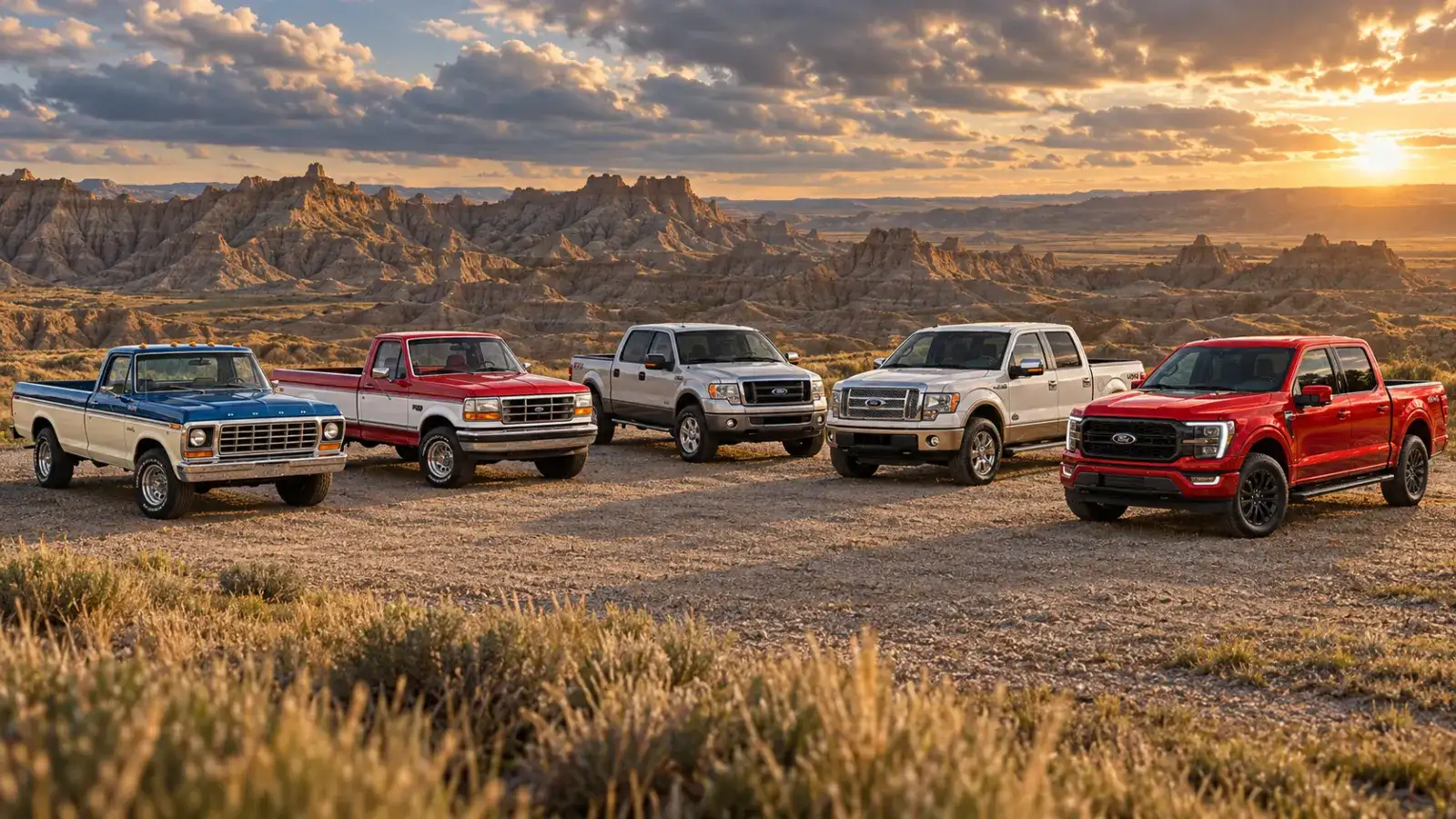
All 14 Ford F-Series and F-150 generations at a glance
| Generation | Years | Buyer note |
|---|---|---|
| First generation | 1948-1952 | The first F-Series trucks. Collector territory today. |
| Second generation | 1953-1956 | The F-100 name entered the Ford truck lineup. |
| Third generation | 1957-1960 | Factory four-wheel drive arrived during this generation. |
| Fourth generation | 1961-1966 | Crew cab joined the body styles during this era. |
| Fifth generation | 1967-1972 | Classic work-truck years. Condition drives the purchase now. |
| Sixth generation | 1973-1979 | Ford introduced the F-150 name for 1975. |
| Seventh generation | 1980-1986 | A lighter redesign began the familiar square-body run. |
| Eighth generation | 1987-1991 | Inspect rust, wiring, brakes, and prior repairs before road use. |
| Ninth generation | 1992-1996 | The last generation before the rounded modern body style. |
| Tenth generation | 1997-2003 | A major shift in design, interior space, and everyday ride quality. |
| Eleventh generation | 2004-2008 | A larger modern F-150. Service records matter. |
| Twelfth generation | 2009-2014 | Steel body. The Raptor performance model arrived. |
| Thirteenth generation | 2015-2020 | Aluminum body over a steel frame. A common used buy. |
| Fourteenth generation | 2021-present | Current platform. PowerBoost hybrid available. 2026 stays here. |
Year ranges: Autoweek F-Series generations guide (updated May 19, 2021). 2026 remains 14th generation on Ford.com.
Major F-150 changes that matter to a buyer
The first six generations explain how the F-Series became the F-150. The seventh through ninth generations define the square-body trucks many owners still restore. The tenth and eleventh generations moved the full-size truck toward more interior space and improved ride quality. The twelfth generation added Raptor to the model line.
The thirteenth generation made the aluminum-body change. The fourteenth generation added PowerBoost hybrid and available Pro Power Onboard generator capability. Current trucks offer more safety features, towing technology, trim packages, and connected systems than previous generations.
Newer technology can make a truck easier to use, but it does not replace a configuration check. Compare body styles, engine options, payload, cargo capacity, and the equipment on the window sticker before comparing model years.
What to inspect before you buy a used generation
Walk the frame with a light. Look at cab corners, bed supports, and brake lines. Cycle 4×4 on dirt or gravel, not only in the parking lot. Check tire date codes. Ask who towed what.
A clean Carfax does not replace a lift. If the truck will pull a stock trailer or a camper through the Hills, weigh your load later and stay under the label on that truck.
Shop F-150s in Belle Fourche
We are at 30 5th Ave, Belle Fourche, SD 57717. Hours: Monday-Friday 8:00 AM-5:30 PM, Saturday 9:00 AM-5:00 PM, Sunday closed. New F-150s, used trucks, financing, and Ford service sit in one place.
Drivers come from Spearfish, Deadwood, Sturgis, Rapid City, and eastern Wyoming when they want a Ford store that will talk through cab, bed, and towing without a script.
F-150 generations FAQ
How many F-150 generations are there?
Fourteen. Autoweek’s guide runs from the 1948 F-Series through the 2021-and-later truck. 2026 is still generation 14.
When did Ford start calling it the F-150?
1975, during the sixth generation. Earlier half-tons used names like F-1 and F-100.
What generation is a 2018 F-150?
Thirteenth generation (2015-2020). Aluminum body over a steel frame.
What generation is a 2026 F-150?
Fourteenth generation. Ford.com lists up to 13,500 lbs towing and 2,440 lbs payload when the truck is properly equipped.
Should I buy used 13th gen or a new 14th gen?
Used 13th gen can be the value play if the body work and service history are clean. New 14th gen makes sense if you want current warranty, hybrid, and the latest tow tech. Drive both at Belle Fourche Ford and compare door labels to your trailer.
Which generation of F-150 is the best?
There is no best generation for every buyer. The thirteenth generation can suit a value-focused used shopper. The fourteenth generation fits shoppers who want current technology and warranty coverage. Condition, configuration, and service history still decide whether a specific truck is a good buy.
Which F-150 years should I avoid?
Do not reject or recommend an F-150 from a model-year list alone. Check recalls by VIN, maintenance records, frame and body condition, warning lights, four-wheel drive, and every feature during a pre-purchase inspection.

0 comment(s) so far on Which F-150 Generation Should You Buy?